If you want to enable crypto payments in an app, you need a full payments stack that handles identity, compliance, fiat conversion, wallet logic, transaction routing, settlement, reconciliation, and fallback rails when something fails.
That is the part many teams underestimate.
The user sees a single button. Your team inherits everything behind it.
Whether you are building a neobank, wallet, gaming app, remittance platform, or marketplace, crypto payments only feel simple when the infrastructure under them is doing a lot of work quietly. The right setup lets your users move between fiat and crypto without friction. The wrong setup turns every payment into a support ticket.
The Short Answer: What Infrastructure Is Needed For Crypto Payments In An App?
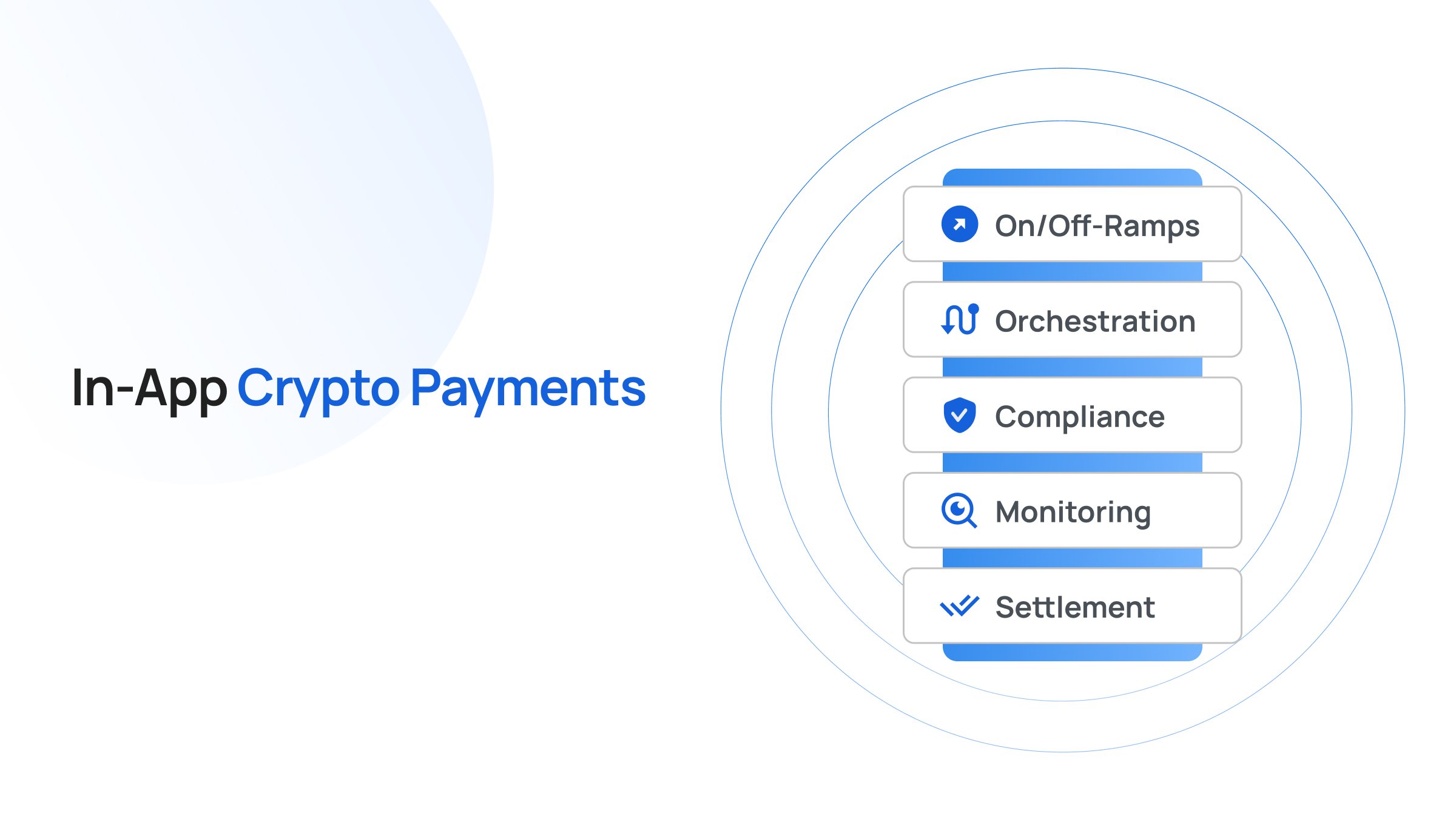
To enable crypto payments in an app, you need six core layers:
- Payment orchestration
- On-/off-ramps
- Compliance
- Transaction monitoring
If your app serves mainstream users, you usually also need fiat rails and a provider that abstracts the messy middle between crypto and local payment systems.
That answer sounds clean. Real implementations are not.
Most apps do not need “crypto payments” in the abstract. They need one or more very specific outcomes:
- let users buy crypto inside the app
- let users pay merchants in stablecoins
- let businesses receive crypto and settle in fiat
- let users cash out to bank accounts or cards
- let treasury or OTC teams move value across borders faster
Each use case changes the infrastructure mix. Still, the building blocks remain mostly the same.
Start With The Payment Flow, Not The Chain
The first infrastructure decision is not whether to use Ethereum, Solana, Base, or Polygon. It is what payment flow you are actually enabling.
A consumer buy flow needs a different stack than a B2B payout flow. A wallet app serving self-custody users needs different controls than a payroll app abstracting crypto entirely. That is why the most useful design lens is the flow itself.
In practice, most app teams end up building around one of these patterns:
Payment flow |
What the app needs to support |
Infrastructure priority |
|---|---|---|
|
Fiat to crypto |
User pays with card, bank transfer, Apple Pay, or Google Pay and receives crypto |
On-ramp, KYC, fraud controls, wallet delivery |
|
Crypto to fiat |
User sells crypto and receives local fiat |
Off-ramp, AML screening, payout rails, reconciliation |
|
Crypto to crypto |
User pays in tokens on-chain |
Wallet UX, gas handling, routing, transaction monitoring |
|
Fiat to crypto to fiat |
Stablecoins act as the transfer rail in the middle |
Orchestration, FX logic, liquidity, on and off-ramp coverage |
|
Programmatic payouts |
Payment triggers from an event, API call, or deposit |
Persistent endpoints, automation, compliance engine, settlement logic |
Also Read: What Are Programmatic Payments and How Transak Enables Them
The Core Layers of Crypto Payments Infrastructure
1. The Fiat On-Ramp and Off-Ramp
This is where most apps start, because it's where most users start.
A user with dollars in their bank or a card in their pocket needs a way to convert that fiat into crypto inside your app. That's the on-ramp. The reverse, i.e., converting on-chain assets back into fiat, is the off-ramp. Without ramps, your app is closed to anyone who doesn't already hold crypto.
When you plug in our ramps, the full stack comes bundled:
- KYC & KYB checks
- Local payment methods (cards, bank transfers, Apple Pay, Google Pay, UPI, PIX, SEPA, wires)
- AML and sanctions screening
- Compliance
For mobile apps, the detail that matters most is whether the ramp flow stays inside your app. Webview redirects that punt users out to a browser are the single biggest cause of conversion drop-off in mobile crypto flows. Our native SDKs, embedded flows, and white-label APIs keep users in-context.
2. Orchestration and Routing Logic
Orchestration is the layer that turns many payment components into one usable flow. It decides how value should move, when conversion should happen, what rail to use, and how to recover if one route fails.
This is the difference between a crypto feature and a crypto payments system.
Without orchestration, your app is gluing together separate vendors and asking engineering to keep the whole machine alive. With orchestration, your app makes one high-level instruction and the system figures out the path.
That path may involve:
- Selecting a stablecoin
- Choosing the best chain based on cost and congestion
- Deciding when fiat conversion should happen
- Matching the correct payout rail on the receiving side
- Handling retries, fallback routing, and reconciliation events
And it matters because many real-world crypto payment stacks are not pure crypto flows. They are hybrid flows.
A user starts in fiat. The payment moves over stablecoin rails. The receiver ends in fiat. That middle section might be on-chain, but the system as a whole is still a payments system. Not a trading system.
3. UX Abstraction For Mainstream Users
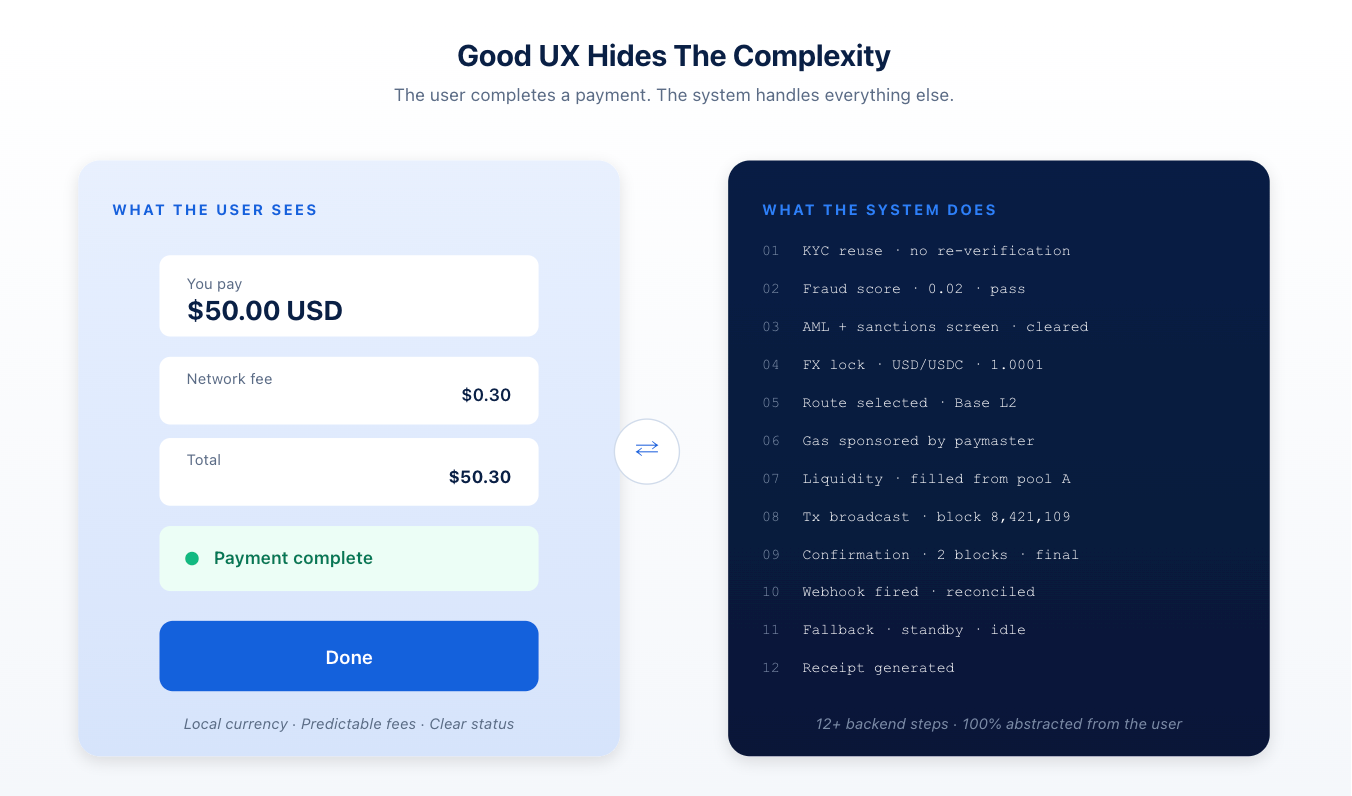
If your app serves mainstream users, the final infrastructure layer is abstraction.
Most users do not want to think in terms of wallets, gas, bridges, slippage, or destination networks. They want to complete a payment.
That means your crypto payments stack must hide complexity where it can. Good crypto payment UX usually includes:
- local currency display
- predictable fees
- network selection handled in the background
- clear status updates
- support for familiar payment methods
- safe fallbacks when a payment cannot complete
Build vs. Buy
Most app teams should not build the full crypto payments stack from scratch.
They should build the product experience and buy the infrastructure layers that are expensive, regulated, and painful to maintain.
That does not mean outsourcing all control. It means being honest about where your competitive advantage actually is.
If you are a consumer app, wallet, neobank, gaming platform, or fintech, your edge is probably distribution, UX, or customer relationship. It is rarely card acquiring, sanction screening, payout coverage, regulatory updates, chain routing, and reconciliation tooling all at once.
Also Read: What Is Infrastructure Fidelity And How To Choose a Payments Partner That Will Not Undercut You
FAQs
Is blockchain integration enough to support crypto payments?
No. Blockchain integration only covers the on-chain part. A usable crypto payments stack also needs compliance, fiat conversion, settlement, reconciliation, fraud controls, and payout rails. That is why most production apps use infrastructure partners instead of chain access alone.
What is the most important infrastructure layer for mainstream crypto payments apps?
For mainstream apps, the most important layer is orchestration. It connects wallets, compliance, fiat rails, and settlement into one usable flow. Without orchestration, users feel every backend decision as friction.
Should apps build crypto payment infrastructure in-house?
Usually not. Most apps should own the user experience and buy the regulated, operationally heavy layers such as on-ramping, off-ramping, compliance, and settlement infrastructure. Building everything yourself only makes sense if payments infrastructure is your actual business.